
 https://www.ulrikequade.nl/ulqua/wp-content/uploads/2026/10/Ooit-ga-ik-dood.-Jij-ook_-Rode-Hoed-JVDPhotography-142-scaled.jpg
1708
2560
Sorcha Ní Bhraonáin
https://ulrikequade.nl/ulqua/wp-content/uploads/2023/01/logo_strepen_vierkant-365x318.png
Sorcha Ní Bhraonáin2026-10-28 21:22:162026-10-28 21:24:05Ooit ga ik dood. Jij ook? at De Rode Hoed
Photo: Paul Sixta
The robot, the puppet and the soul
Ulrike Quade on bringing technology to life on stage
What if a robot became an opera singer? If steel and code could form a duet that moves us? For director and artistic researcher Ulrike Quade, the theatre is the place where human and machine meet — not in confrontation, but in poetry.
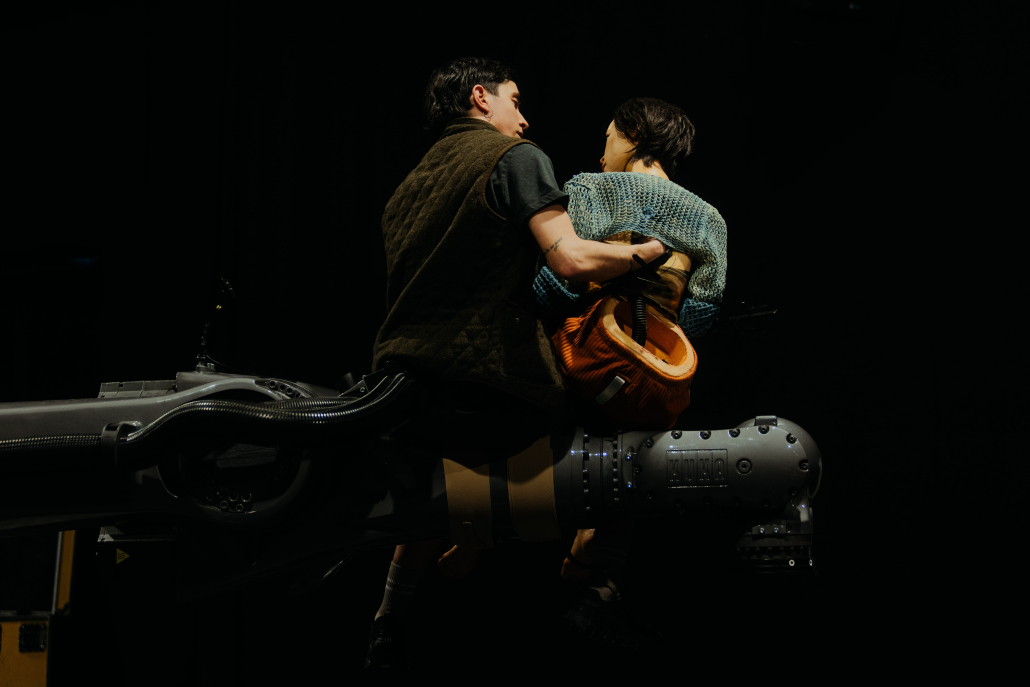
On 14 May, together with opera director Lisenka Heijboer Castañón and composer Stephanie Pan, she presented the Techlab session Making New Opera with a Robot at Studio Boekman. On stage: the industrial robot arm KUKA and the traditional Japanese Bunraku puppet ORITO. Together, they explored a new form of opera in which technology is not just an instrument but a full-fledged performer.
The presentation offered audiences and professionals a glimpse into the creative process and marked an important step towards a new opera to be developed further in the coming period. Afterwards, Ulrike spoke about their working methods. In the interview, she reflects on her work with objects, algorithms, and the “soul” of the robot — an inquiry into how life and presence can emerge on stage in the encounter between human and machine.
“The robot is no longer the ‘other’, but a partner in a story. Not because it is human, but because we are willing to attribute humanity to it. In that projection lies the magic of theatre — and perhaps a glimpse of our future.” — Ulrike Quade
When technology begins to sing
In the presentation, the industrial robot arm KUKA transformed into an opera performer with its own musical voice. Not words, but sound, rhythm, and movement formed its language. Together with composer Stephanie Pan, Ulrike lets the robot sing — not like a human, but breathing as an object with intent. “It is not about imitating life, but about evoking presence,” Ulrike explains. “What moves us is not the appearance, but the suggestion of an inner world.”
Like the Bunraku puppet ORITO — animated by three visible puppeteers — KUKA evokes something larger than technology. Where ORITO conveys humanity, KUKA embodies distance and solitude. Together, they create a layered choreography in which tradition and technology complement rather than exclude each other. “One breathes humanity, the other disrupts it,” says Ulrike. “It is precisely in that tension that meaning arises.”
The magic of projection
What happens between a performer and a puppet, or between a robot and a spectator? For Ulrike, that is the essence of her work. “Illusion does not arise from movement alone, but from relationship. The puppet lives by the grace of its players. The robot moves autonomously, and that evokes a different projection in the audience. Both are empty — but as soon as we assign meaning, a character is born.”
In her work, Ulrike investigates how objects can gain a soul — not biologically, but relationally. Life arises in interaction, in the space between seeing and believing. She plays with rhythm, delay, and silence: elements that give the object breath. Even the smallest glitch in a programmed movement can shatter — or deepen — the illusion. “That moment of fragility makes it human. That is the moment when technology becomes poetry.”
Music plays a crucial role in this process. Sounds generated by the robot’s movements are transformed into a voice in collaboration with composer Stephanie Pan. “In this way, a presence emerges that cannot be rationally explained, but can be felt.”
Between control and chance
Ulrike deliberately seeks the tension between control and chance. How do you evoke empathy for an object without a face or voice? In puppetry, there is room for accident. KUKA moves with perfect precision but cannot improvise. Yet something alive emerges in the interaction between human and machine. “The robot does not need to play emotions,” says Ulrike. “But the moment it seems to want something — reaching, waiting, hesitating — empathy arises.” Where ORITO allows improvisation, KUKA moves with absolute precision. But in the interaction between performer and robot, even programmed perfection can feel like dialogue. “The audience fills in the emptiness. That is the power of theatre.”
It is precisely that estrangement — that a cold machine can stir something within us — that makes the work powerful. “We recognize ourselves in something fundamentally different. That is not a trick, but an invitation to reflect.”
Tradition versus technology
The Bunraku puppet ORITO and the industrial robot arm KUKA represent seemingly opposite worlds: human craftsmanship versus technological precision. Yet on stage they find each other. “Both are empty, yet full of potential,” says Ulrike. “As soon as the audience begins to project meaning, characters arise. Theatre becomes a space for imagination — for rethinking what ‘life’ means.”
Technology as a carrier of emotion
Where technology is often thought to create distance, Ulrike sees the potential for new sensitivity. “The contrast between steel and skin, between machine and human, makes something tangible. The robot shifts the human from the centre, and the human, in turn, questions the robot. We are invited to redefine our relationship to the world.”
For Ulrike, the robot is not a gimmick, but a full-fledged performer. In her vision, technology becomes a storyteller — a carrier of emotion, doubt, and comfort. Opera as a Gesamtkunstwerk gains a new layer: a hybrid space where body, sound, image, and machine merge.
A duet between ORITO and KUKA
The presentation revealed a poetic dialogue with the urgency of the moment. What does it mean if we recognize ourselves in a machine? If an object can teach us something about desire or loss? “In rehearsals we call it ‘world building’ and ‘becoming’: it is not about fixed meaning, but about creating room for interpretation.”
In this world, Ulrike sees her role as that of a bridge-builder. “Between craft and experiment. Between the body and the machine. My task is to keep applying poetry in a rapidly changing reality.”
The questions of KUKA
What does Ulrike want the audience to take away? “A moment of wonder. KUKA offers no answers but asks questions — above all about our co-existence with technology. That is precisely why she belongs on stage.”
An opera in the making
The Techlab session of 14 May offered a first encounter. Fragments and insights from the presentation now form the basis for the continued development of the opera, in which human, puppet, and robot will meet again.
Het onderzoek gaat door, en de komende tijd wordt verder gebouwd aan een hybride universum van muziek, poppenspel en robotica. The research continues, and in the coming period a hybrid universe of music, puppetry, and robotics will be further shaped.
Read more
https://www.ulrikequade.nl/ulqua/wp-content/uploads/2026/10/Ooit-ga-ik-dood.-Jij-ook_-Rode-Hoed-JVDPhotography-142-scaled.jpg
1708
2560
Sorcha Ní Bhraonáin
https://ulrikequade.nl/ulqua/wp-content/uploads/2023/01/logo_strepen_vierkant-365x318.png
Sorcha Ní Bhraonáin2026-10-28 21:22:162026-10-28 21:24:05Ooit ga ik dood. Jij ook? at De Rode Hoed
 https://www.ulrikequade.nl/ulqua/wp-content/uploads/2026/10/ulrike-japan-snow-scaled.png
2560
1978
Sorcha Ní Bhraonáin
https://ulrikequade.nl/ulqua/wp-content/uploads/2023/01/logo_strepen_vierkant-365x318.png
Sorcha Ní Bhraonáin2026-10-07 13:42:352026-10-07 14:01:05From the Archive: Puppets & Gods in Japan

 https://www.ulrikequade.nl/ulqua/wp-content/uploads/2024/12/Cropped-metahuman.png
1657
2421
Sorcha Ní Bhraonáin
https://ulrikequade.nl/ulqua/wp-content/uploads/2023/01/logo_strepen_vierkant-365x318.png
Sorcha Ní Bhraonáin2026-10-06 17:25:252026-10-15 09:14:29Immersive Experience Day for Performing Arts

Photo: Erfan Abdi
“By bringing together science, technology, and art, we create a powerful space for innovation—one that challenges social norms and opens new perspectives on the issues shaping our world today.”
– Ulrike Quade
